Chad Duty, Chief Executive Officer at IACMI
Chad Duty is the Chief Executive Officer of the Institute for Advanced Composites Manufacturing Innovation (IACMI, or IACMI – The Composites Institute), a role he assumed April 1, 2023. IACMI is a U.S. Department of War (DoW)-sponsored public/private partnership targeting high-volume applications of composites in energy-related industries.
A professor in the Mechanical, Aerospace & Biomedical Engineering Department at the University of Tennessee, Knoxville, Chad also holds a joint faculty appointment with the Oak Ridge National Laboratory (ORNL).
He has over 20 years of research experience in advanced manufacturing – spanning technologies in thin film processing, printed electronics, solar energy, and additive manufacturing of polymer composites. Before joining UT, Chad served as a research scientist and group leader at ORNL and helped to establish the DOE’s Manufacturing Demonstration Facility at ORNL. Duty began his career as a senior aeronautical engineer at Lockheed Martin.
He has a doctorate in mechanical engineering from Georgia Tech and bachelor’s degree in mechanical engineering from Virginia Tech.
Elliot Keas, ACE Program Director at IACMI
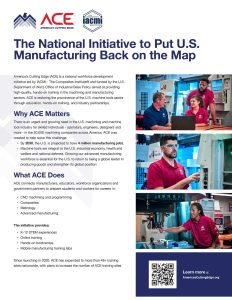
Elliot Keas serves as the Director of the ACE Program at IACMI, where he leads national workforce development initiatives focused on strengthening the U.S. manufacturing talent pipeline. Prior to joining IACMI, Elliot built his career across multiple sectors of advanced manufacturing, including automotive, defense, and heavy equipment production.
Beginning in 2017 as a cooperative education student in a high-pressure die casting facility, Elliot advanced into manufacturing engineering roles supporting Tier 1 automotive production, where he managed die casting and precision machining processes for torque converter manufacturing serving major OEMs including General Motors and Ford. He later joined a Fortune 350 manufacturing corporation, supporting defense manufacturing efforts focused on welded and fabricated systems for the Joint Light Tactical Vehicle (JLTV) program.
Elliot subsequently transitioned to JLG Industries, where he served in a chief engineering leadership role overseeing a 600,000-square-foot manufacturing operation and supporting approximately 300 employees. His responsibilities included robotic and manual welding operations, automated paint systems, autonomous material delivery technologies, capital project execution, and manufacturing cell design focused on safety, efficiency, and operational flexibility.
Today, Elliot leverages this diverse industry experience to help expand advanced manufacturing workforce programs nationwide, connecting industry, education, and government partners to develop the next generation of skilled manufacturing professionals through the ACE program.