
Northland will hold its first bootcamp July 13-17 at no cost to participants
THIEF RIVER FALLS, Minn. (May 4, 2026) – Whether you’re exploring a career in advanced manufacturing or looking to strengthen your current skill set, Northland Community & Technical College (Northland) is offering a new opportunity to get hands-on experience in composites manufacturing at no cost.
Northland is now hosting free, weeklong composites bootcamps through America’s Cutting Edge (ACE), a national workforce training initiative managed by IACMI–The Composites Institute. The bootcamps combine classroom learning with hands-on training using the same equipment and technology found in modern manufacturing facilities.
Led by industry experts, ACE bootcamps immerse participants in real-world applications of composites manufacturing. Attendees will operate equipment, learn shop safety practices, and gain exposure to advanced materials and processes that are in high demand across aerospace, defense, transportation, and other manufacturing sectors.
“If you’re in industry, you’ll get access to cutting-edge information to help you achieve better productivity, efficiency or cost-savings,” said Andrew Pokelwaldt, IACMI Director of Workforce and Education. “And if you’ve never heard of composites, this is a great opportunity to see why you should get involved.”
During the weeklong bootcamp, participants will:
● Receive an introduction to composite materials and manufacturing
● Practice shop safety and work with composite manufacturing equipment
● Build their own composite glider project
● Participate in industry tours and networking opportunities
● Earn a digital badge and certificate of completion
“Northland is pleased to partner with IACMI–The Composites Institute to bring these hands-on composites bootcamps to our region,” said Kirsten Michalke, Dean of Workforce Development and Aerospace Campus at Northland. “Designed for participants ages 16 and older, these free bootcamps are open to high school students, college students, and individuals currently working in industry. They offer a unique opportunity to explore emerging career pathways in composites or expand existing skills in a growing field.”
Northland’s Inaugural Composites Bootcamp
July 13–17, 2026
Location: Northland Community & Technical College, Thief River Falls (Aerospace Campus)
Enrollment is limited to 15 participants, with spots filled on a first‑come, first‑served basis.
Register today: www.northlandcollege.edu/wds/bootcamps
Completion of the ACE Composites in Aerospace online course is a required prerequisite for bootcamp attendance. Registrants will first complete Introduction to Composites before enrolling in Composites in Aerospace. Get started here.
The refreshed America’s Cutting Edge Fusion CNC Machining course features short, engaging lessons designed to fit your busy schedule.
March 9, 2026 – Learning CNC machining just became more engaging and easier to complete.
Participants in the free online America’s Cutting Edge Fusion CNC Machining course can now experience a refreshed learning format built around short microlessons and interactive features, designed specifically for today’s busy learners.
Following months of feedback from students, instructors, industry partners, and other stakeholders, the course has been updated to better support how people learn today.
Learn quicker
The refreshed course introduces microlesson videos – in some cases lasting under one minute – making it easier to start, stop, and return to learning without losing momentum.
Learn by doing, not just watching
Interactive features help reinforce key concepts and improve retention, including:
- Drag‑and‑drop labeling for equipment
- Clicking through on‑screen buttons
- Matching information through multiple‑choice drop‑down menus
“Participants will stay more engaged now,” says Dave Roberson, IACMI manager of workforce trainers. “They’ll retain more from the online course, which will help them be better prepared for an ACE in-person bootcamp.”
“This update is a direct investment in the learner experience, and shows we’re listening to feedback,” says Justin Brooks, IACMI deputy director of workforce development. “It takes strong content we’ve built over time and modernizes how it’s delivered so it’s easier to access, easier to absorb, and easier to complete.”
Together, these updates transform the ACE online experience from passive learning into active learning, helping participants remember more and progress with confidence.
For learners balancing work, school, or other commitments, the shorter lessons make it easier to fit training into a busy schedule.
“It also makes the course more usable across different audiences, including students, incumbent workers, and instructors who want to integrate modules into training plans without losing alignment to ACE’s learning objectives,” Brooks adds.
A modern path into a modern career
The refreshed format also positions CNC machining as a modern, in‑demand career path.
The online course introduces CNC machining fundamentals while covering topics such as:
- Computer‑aided machining
- Machining dynamics
- Machining cost
- …and more
“I strongly believe skilled trades, like CNC machining, are one of the most valuable and overlooked career pathways,” says Kelly Gideon with Texas A&M University, who was the lead project specialist for the course redesign.
“Getting to collaborate with ACE to redesign a world‑class CNC training program to introduce more people to CNC machining was not only personally fulfilling, but vital to national security and the manufacturing industry,” she adds.
Be among the first to experience the improved ACE Fusion CNC Machining course by clicking here.
Dec. 8, 2025 – It all started at a kitchen counter in 2020.
Dr. Tony Schmitz was preparing something that would balloon into a nationwide initiative: the first online CNC machining course for the America’s Cutting Edge program.
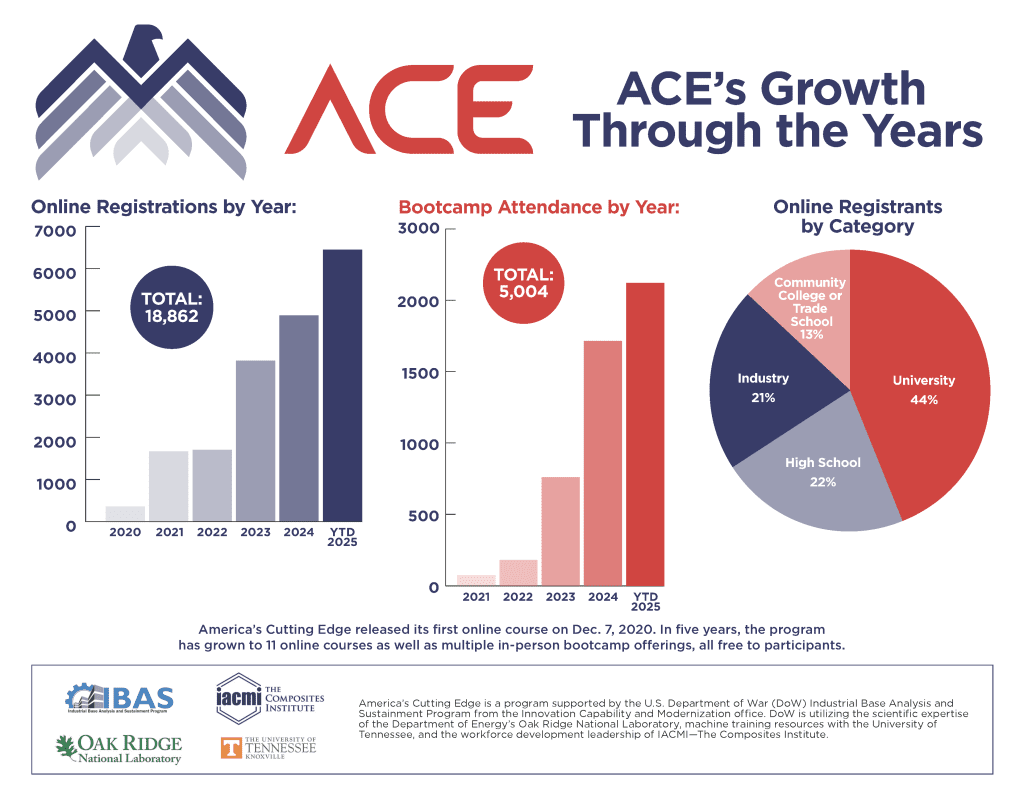
The rollout began on Dec. 7, 2020. Like a snowball rolling downhill, the results have turned into an avalanche.
ACE’s Early Years
In the summer of 2021, ACE began offering in-person, bootcamp-style training opportunities to bridge the gap from online learning to hands-on application.
Pellissippi State Community College (PSCC) in Knoxville, TN, was an early testbed site for these training opportunities.
PSCC continues to provide ACE training to a wide variety of participants today. Andy Polnicki, ACE program coordinator at PSCC, notes that the impact has had far reach.
“Youth participants progress through a clear pipeline, starting with camps, continuing as students, and ultimately entering the workforce,” he said.
“And local companies utilize our classes to upskill their staff and enhance their confidence in their equipment investments. Witnessing this level of alignment between industry needs and student success has been incredibly rewarding.”
That same success has been found at Texas A&M Engineering Experiment Station (TEES), which became a partner in 2022.
Although they began as the lone Texas site in College Station, they’ve grown to be the largest hub-and-spoke network within ACE, with around a dozen sites connected to them.
With the size and strength of the TEES network, over 1,100 bootcamp participants have been trained in Texas.
Those participants include Macrae Alford, who came to ACE with no CNC experience and later got hired and became a CNC operator; as well as Julio Gutierrez, whose ACE experience at Mayday Manufacturing leveled up his career – and his pay.
“TEES is deeply grateful to the Department of War and IACMI whose support has empowered more than 1,100 Texans to gain essential CNC machining skills to build life-changing careers through a robust hub and spoke network in Texas,” said John Peterson, ACE program coordinator at TEES.
“Their commitment to TEES and our regional training partners has helped us close critical skill gaps, strengthen key defense industrial partnerships, and secure a more competitive, resilient workforce for the future.”
Exponential Growth Begins
In 2023, ACE started experiencing a serious momentum shift.
Through the end of 2022, just over 3,800 people had registered for an online course. In 2023 alone, 3,800 more people did the same – doubling registrations within the year.
Similarly, under 300 people had participated in a bootcamp heading into 2023. By the end of the year, that tally was nearly 1,000.
St. Cloud State University (SCSU) inked its partnership with ACE that summer and began work to refurbish a 56-foot-long trailer designed to become a mobile machining classroom.
It would later become everything needed to run the ACE program remotely from places like a company parking lot. In fact, Coldspring – a fabricator of granite products – has done just that, sending three cohorts through training on the trailer to date.
“There’s a bunch of different benefits to having the trailer come right to our site,” said Josh Reitmeier, Coldspring director of operations. “Employees don’t have to go to some place they’ve never been. It becomes very convenient for them. This feels like something everybody could benefit from.”
Kurt Helgeson, ACE program coordinator at SCSU, adds that high school teacher training has also been a force multiplier in Minnesota.
The formula is simple: Teachers get trained at SCSU, then they train their classes of students.
“ACE has allowed us to expand on our Technology, Engineering and Careers Network, which brings industry standard equipment to schools,” he said. “We have three Haas mills that we’ve made portable to take to schools which don’t have the CNC capacity due to cost or space.”
Through the effort, over 30 teachers have been ACE-trained, impacting over 125 high school students.
‘A Culture Shift’
While most ACE partner sites provide training to a consistent, steady amount of people, few have hit the ground running quite like Mississippi State University (MSU).
Despite being a newer ACE partner site – having started in 2024 – they’ve already trained over 350 people.
That’s the second-most in a network of over three dozen sites.
“When Mississippi State joined the ACE program in 2024, we made a deliberate decision that this wouldn’t just be another training offering. It would be a culture shift,” said Ross Smith, ACE program coordinator.
“Once students realize they can walk into a lab, run a CNC machine, program toolpaths, or complete a composite layup on their own, they start to see themselves as engineers and technicians, not just students,” he added. “That’s powerful.”
An additional hallmark of MSU’s success has been their approach to Mississippi manufacturers.
Those conversations have led directly to several industry-focused bootcamps, featuring folks from bigger companies like Milwaukee Tool, to smaller, local companies like Taylor Machine Works.
“Working with industry has been phenomenal. Mississippi manufacturers, from aerospace to heavy equipment, have been eager to engage because they feel the workforce pressure every day,” Ross added.
“ACE gives them a direct pipeline of talent that is already trained on the equipment they use, and it gives them confidence that Mississippi has a statewide strategy for manufacturing excellence. We’ve had industry professionals come in for training, send their teams to our bootcamps, and collaborate with us on real production challenges. That feedback loop keeps ACE relevant and immediately applicable.”
Like SCSU and Coldspring, the companies MSU is working with have plans to come back for more.
Beyond CNC Machining
We arrive to Dec. 7, 2025 – ACE’s fifth birthday.
Over 40 sites have joined the ACE network.
Nearly 20,000 people have registered for an online course.
And over 5,000 have done an in-person bootcamp.
While the numbers make this birthday special, they’re only part of the reason this fifth rotation around the sun makes for a banner year.
Entering 2025, all ACE partner sites have been focused on ACE’s trademark CNC machining courses for their bootcamp offerings.
That changed this summer.
Winona State University (WSU) joined the ACE network this year as the first ACE Composites hub. They’re running bootcamps to introduce participants to composites products and processes relevant to the automotive industry.
The curriculum follows content found in the ACE Composites in Automotive online course.
“I am grateful to have been a part of pioneering this work,” said Eric Kerr-Anderson, ACE program coordinator at WSU. “The ability to craft a curriculum geared at a week-long exposure to thermoplastic and thermoset manufacturing techniques for the ACE program has helped me ensure there are educational opportunities for composite manufacturing available to anyone that’s interested.”
For Andy Pokelwaldt, IACMI’s director of workforce and education, it’s a natural step in the right direction as ACE meets the call to revitalize the domestic manufacturing workforce.
“I see the future continuing to build on successful ACE training outcomes,” Andy said. “With increased demand for positive training results, ACE is positioned to meet more U.S. industry technical areas of delivery with increased partners being involved in meeting that demand nationwide.”
A Moment of Gratitude
Although the numbers are great, it’s the stories of those impacted that make ACE what it is.
Whether it’s Joshua Britt, a North Carolina father who both leveled up his career and showed his son what manufacturing looks like, or Ashley Egenti, whose ACE experience helped her start her career at Lockheed Martin, it’s their journeys – among the many other ACE participants – that have defined this growth as a real success.
It’s not just about numbers on paper.
It’s about lives changed.
Dave Roberson, ACE’s instructor trainer, perfectly sums it up on behalf of the ACE team. “This is the breath of fresh air the machining industry has needed. I couldn’t be happier to be a part of ACE.”
Start your journey by clicking here.
BELLEVILLE, Ill. (March 31, 2025) – Career advancement. Improved productivity. Cost savings.
These are a few of the benefits you could get after the latest development in a partnership between the Institute for Advanced Composites Manufacturing Innovation (IACMI) and Mastercam.
Last year, the two organizations announced a combined effort supporting America’s Cutting Edge (ACE), an IACMI-managed workforce development program focused on revitalizing the United States machining industry. Mastercam was added as a featured option for ACE’s no-cost online curriculum.
Today, the advantages for students, manufacturing employees and companies are raised as Mastercam and IACMI announce the software has been added to ACE’s no-cost, in-person training offerings.
“Mastercam is dedicated to investing in education and ensuring the future of manufacturing by providing students with access to the latest advancements in CAD/CAM software,” said Peter Mancini, Education Manager at Mastercam. “Our commitment to education is reflected in our partnerships with programs like ACE which prepares students for successful careers in manufacturing.”
“We’re thrilled to expand our ACE in-person CNC machining training capabilities to include Mastercam programming,” said Dr. Tony Schmitz, ACE curriculum developer. “Our intent is to provide industrially-relevant machining experiences for our participants and this partnership increases our opportunities.”
The inaugural Mastercam bootcamp was held this month at Southwestern Illinois College (SWIC), located east of St. Louis, Missouri. SWIC was selected to host the first Mastercam-focused bootcamp in the ACE network because of its strong connection to the software and newly updated facilities.
“SWIC has long utilized Mastercam in our machining programs, and we’re excited to see it integrated into the ACE curriculum,” said David J. Berry, Coordinator at Southwestern Illinois College. “Mastercam is the most utilized computer-aided machining software in our local industry and our team is excited to have the opportunity to pilot the program at our new Advanced Manufacturing Academy.”
Participants in the bootcamp will use the software as part of classroom-style instruction and hands-on CNC machining training.
More ACE partner sites will host Mastercam bootcamps in the future. To find an ACE site near you, click here. A schedule of upcoming in-person training offerings can be found here.
To qualify for an in-person bootcamp, the online ACE Mastercam CNC machining course must be completed first. Click here to register.
WINONA, Minn. (March 25, 2025) – Winona State University will partner with the Institute for Advanced Composites Manufacturing Innovation (IACMI) to support advanced composites manufacturing training that aligns with the needs of the regional industry and supports the U.S. Department of Defense Industrial Base Analysis and Sustainment program.
The groundbreaking new partnership with IACMI designates Winona State as the first composites hub in the national, IACMI-managed America’s Cutting Edge (ACE) program, and highlights WSU’s commitment to enhancing workforce development, advancing community and student benefit, and supporting the revitalization of U.S. manufacturing.
This partnership will fund free, hands-on bootcamps that teach advanced skills in composites manufacturing and provide valuable opportunities for current Winona State students, alumni, and other area students. 2025 bootcamps will be held June 2–6, July 7–11, and Aug. 4–8 on the Winona State campus.
The bootcamps will focus on Composites in Automotive, one of several ACE Composites units, and will serve as a key resource for students seeking to gain valuable skills in a growing industry. Participants will connect with national experts in the field and learn directly from those at the forefront of U.S. manufacturing innovation. The program is designed to engage individuals from diverse educational backgrounds, including those with no prior experience in manufacturing.
“This partnership represents a monumental step forward for Winona State University, our students, and our community,” said Eric Kerr-Anderson, Associate Professor of Composite Materials Engineering at Winona State. ”Not only will this partnership provide hands-on experience and advanced manufacturing training to students, it also enhances our university’s role as a hub of innovation, creating new career opportunities and strengthening our local economy.”
The partnership with IACMI will fund the acquisition of state-of-the-art equipment that can be used by both Winona State students and bootcamp participants. In addition, as part of the ACE initiative, WSU will hire student employees to gain hands-on experience working with this cutting-edge equipment, preparing them for careers in advanced manufacturing.
“Our partnership with Winona State University and the ACE program is a pivotal investment in workforce development,” said Dr. Uday Vaidya, Chief Technology Officer, IACMI. ”Through this initiative, we are building a sustainable, diverse workforce equipped with the skills needed to thrive in modern manufacturing careers.”
This new ACE hub adds to a growing network of workforce development centers dedicated to advancing U.S. manufacturing. To date, over 13,000 people have registered for an ACE online course and more than 2,900 students have completed an in-person bootcamp, all at no cost to participants.
Interested students, alumni, and community members can register for the bootcamps and find out more information about the program by visiting the registration page.
America’s Cutting Edge, managed by the Institute for Advanced Composites Manufacturing Innovation, has added Mastercam as a featured option for program participants
April 10, 2024 – The machining industry’s talent pipeline just got a huge boost.
The Institute for Advanced Composites Manufacturing Innovation (IACMI) and Mastercam announced today their partnership supporting America’s Cutting Edge (ACE), a workforce development program targeted at revitalizing the United States machining industry through online and in-person training.
ACE connects top national experts with students and incumbent industrial workers from diverse backgrounds, levels of education, and work experience to build interest in all facets of machining, including software development, metrology, design, operation, and entrepreneurship. To date, ACE has delivered online courses to more than 9,000 students from all 50 states and in-person bootcamp style training to more than 1,200 students, all at no cost to participants.
Prior to today, there was only one other computer-aided manufacturing (CAM) software ACE provided for its online computer-numerical control (CNC) machining course.
This partnership between IACMI and Mastercam will open the ACE machining course to a much wider audience, as Mastercam is the world’s most widely used CAM software.
“I am thrilled to add Mastercam as an ACE partner,” said Dr. Tony Schmitz, ACE curriculum developer. “As we expand our reach, we want to provide opportunities for our participants to choose their computer-aided manufacturing software to match their current and future needs. This partnership makes our program more accessible to students as Mastercam is the most widely used CAM software.”
Peter Mancini, Manager of Education at Mastercam, noted, “At Mastercam, we take pride in the fact that our customers shape the future of manufacturing, so we are excited to partner with America’s Cutting Edge and its national initiative to restore the prominence of the US machine tools sector.”
When registering for the CNC machining course, participants will choose their preferred CAD/CAM program. They may also choose to complete both pathways online.
Schmitz believes this will lead more prospective or current machining professionals to become ACE certified.
“I anticipate that we’ll increase ACE participation through this partnership,” said Schmitz. “It is our intent to provide the CNC machining course to both add new participants to the machining pipeline and provide training on the relationship between vibrations and machining parameter selection for those already familiar with CNC machining. This partnership will provide new learning opportunities for those already using Mastercam.”
“This partnership provides an outstanding product as an option for America’s Cutting Edge machining students,” said Joannie Harmon, IACMI vice president of workforce development. “Those who are familiar with or curious about Mastercam will benefit from the training ACE provides, and industry will benefit as more people get the skills they need to fill critical positions. All in all, it means a larger pipeline of talent; it’s a win-win.”
The Mastercam path is available now. Click here to register for it.
About ACE
America’s Cutting Edge, supported by the U.S. Department of Defense (DoD) Industrial Base Analysis and Sustainment program, is a national computer numerical control machine training program designed to reestablish American leadership in the machine tool industry through transformative thinking, technological innovation, and workforce development. The curriculum combines advanced training tools and techniques from the University of Tennessee, the scientific expertise of the Department of Energy’s Manufacturing Demonstration Facility at Oak Ridge National Laboratory and the proven workforce development capabilities of IACMI.
ACE has expanded beyond the initial testbed of the University of Tennessee to include seven training hubs at North Carolina A&T State University, Texas A&M Engineering Experiment Station, Marshall University Advanced Manufacturing Center, University of Florida, St. Cloud State University (Minn.) and University of St. Thomas (Minn). There’s a growing network of over two dozen machine tool training partners in 11 states, including high schools, trade schools and community colleges.
About IACMI
IACMI – The Composites Institute is a 145-plus member community of industry, universities, national laboratories, and federal, state, and local government agencies working together to benefit the nation’s energy, manufacturing, and economic security. IACMI is managed by the Collaborative Composite Solutions Corporation (CCS), a not-for-profit organization established by The University of Tennessee Research Foundation. A Manufacturing USA institute, IACMI is supported by the U.S. Department of Energy’s Advanced Materials Manufacturing Technologies Office, as well as key state and industry partners.
Emerging national network of machine tool workforce development centers supported by Department of Defense aims to revitalize American manufacturing
KNOXVILLE, TN (September 14, 2023) – The Institute for Advanced Composites Manufacturing InnovationÒ (IACMI), in partnership with Department of Defense (DoD)’s Manufacturing Capability Expansion and Investment Prioritization (MCEIP) office, announced today it is expanding America’s Cutting Edge (ACE) into Minnesota.
A national initiative aimed at revitalizing U.S. manufacturing, ACE is adding two new innovation and workforce development centers in Minnesota: St. Cloud State University (SCSU) and the University of St. Thomas. Focused on different rural and urban populations, both schools together are taking a strategic approach to provide essential training in manufacturing across the entire state. ACE, which has regional machine tool training centers in Florida, Kentucky, New Jersey, North Carolina, Ohio, Tennessee, Texas, West Virginia and now Minnesota, provides free online and in-person training in the machine tool industry–training that’s key to America’s national security and continued economic vitality.
“We are excited about the impact this program will make in the Twin Cities community,” said John Wentz, Director of Advanced Manufacturing at St. Thomas. “ACE compliments St. Thomas’ history of hands-on engineering education and expands our ability to introduce CNC machining to new populations, such as high school students interested in engineering and technology fields.” In addition to offering ACE to their engineering students, St. Thomas is targeting specific audiences like incumbent workers and veterans. Wentz added, “St. Thomas has prided itself on working closely with Minnesota industry through senior design and research projects, and we’re excited to support their workforce needs through this program.”
St. Cloud State University is taking a different approach with a 53-foot semi-trailer as a mobile training center, ideal for reaching rural communities throughout Minnesota. They’re starting with training teachers in their Technology Engineering and Careers (TEC) Network this fall and will then drive the unit equipped with portable Haas Mills to all qualifying schools and companies by spring 2024. Just like other TEC Network equipment, SCSU staff will train instructors in advance and deliver the machines and materials to their locations, all at no cost. CEU and college credits will be available to successful graduates of the program.
“We are building on our strengths here at SCSU as ACE will expand the training opportunities of our TEC Network. The addition of making this program available through SCSU’s mobile platform allows us to take this much-needed training opportunity on the road as we reach teachers and students across Minnesota,” said Dr. Kurt Helgeson, an SCSU professor in the Department of Environmental and Technological Studies and ACE Program Director. “The ACE initiative aligns with SCSU’s focus on providing innovative learning experiences to serve a need and meet the demands of our workforce.”
ACE is comprised of two parts. The first is an online requirement that covers an introduction to Computer Numerical Control (CNC) machining and 3D modeling using Fusion 360. Additional courses in metrology, composites, and cybersecurity have been added. Upon completion, students become qualified to advance to hands-on lab training. Whether in an engineering department or a mobile shop, “bootcamps” provide opportunities for eligible students to learn in a high-intensity environment through hands-on, in-person training—all at no cost.
Launched in 2020, ACE is a public-private partnership established between MCEIP’s Industrial Base Analysis and Sustainment program, the Department of Energy’s Manufacturing Demonstration Center at Oak Ridge National Laboratory, and IACMI. Managed by IACMI, ACE aims to close the skills gap and restore American dominance in machine tool technology and innovation. Through ACE, a national CNC machining training program was developed by University of Tennessee, Knoxville (UT) Professor Tony Schmitz. More than 5,500 people from all 50 states are engaged in online training and nearly 700 have completed in-person training.
“Machining and machine tools are at the foundation of America’s manufacturing capability and its global competitiveness,” said IACMI Workforce VP Joannie Harmon. “We have a critical workforce skills gap in this country when it comes to machine tool resources. The training component of ACE is intended to help our nation recover, advance, and sustain technical and manufacturing positions – all to enable a strong, resilient, and responsive U.S. industrial base.”
ABOUT IACMI
IACMI – The Composites Institute is a 140-plus member community of industry, universities, national laboratories, and federal, state, and local government agencies working together to accelerate advanced composites design, manufacturing, technical innovation, and workforce solutions to enable a cleaner and more sustainable, more secure, and more competitive U.S. economy. IACMI is managed by the Collaborative Composite Solutions Corporation (CCS), a not-for-profit organization established by The University of Tennessee Research Foundation. A Manufacturing USA institute, IACMI is supported by the U.S. Department of Energy’s Advanced Materials & Manufacturing Technologies Office, as well as key state and industry partners.
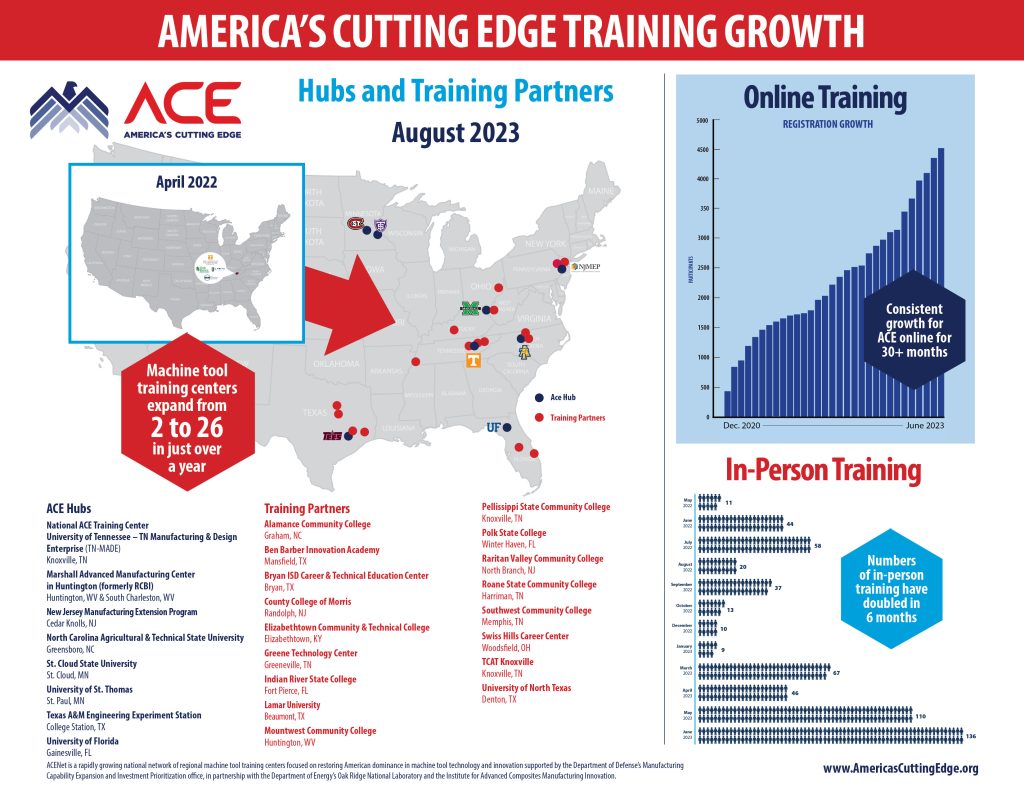
Expanding Machine Tool Training Centers Doubles Number of Trainees in 6 months
August 31, 2023 — In celebration of upcoming Labor Day which honors hard working Americans, the Institute for Advanced Composites Manufacturing InnovationÒ (IACMI), in partnership with the Department of Defense (DoD), announced today that in the first half of 2023 it has doubled the number of people trained through its highly successful workforce development program, America’s Cutting Edge (ACE).
A national initiative to restore the prominence of U.S. machine tool technology and innovation, ACENet is a rapidly growing network that has doubled in-person trainees in computer numerical control (CNC) machining in the first six months of 2023. From March 2021 through December 2022, 300 participants completed the hands-on, in-person training. By June 2023, that number had more than doubled to 638, thanks to the expanding network of regional machine tool innovation and workforce development centers that IACMI is scaling up across America with DoD support.
ACENet is a public-private partnership funded by the DoD’s Manufacturing Capability Expansion and Investment Prioritization (MCEIP) office, which manages and executes the Industrial Base Analysis and Sustainment (IBAS) program. ACENet has expanded its in-person curriculum to more than 20 machine tool training centers in 9 states. These include Tennessee, North Carolina, Texas, West Virginia, Florida, Ohio, Kentucky, New Jersey, and most recently added, Minnesota. Together, they have hosted 30 training sessions called “bootcamps” in 2023 alone.
“You never forget the first time you machine something yourself,” said Adele Ratcliff, director of MCEIP’s Innovation Capability and Modernization (ICAM) office. “For many, ACE bootcamps are their first chance to run these machines. I’m confident that by expanding opportunities to engage in that process, more people in this next generation will be inspired to come into manufacturing and machining. Additionally, I’ve seen data showing that even highly experienced machinists and shop owners recognize the information presented in this course helps improve their overall effectiveness and efficiency.”
Much of the ACENet content was developed in 2020 by Dr. Tony Schmitz, who serves as a professor for the University of Tennessee, Knoxville (UT) and joint faculty for Oak Ridge National Laboratory (ORNL). ACE brings together the scientific expertise of ORNL, advanced training tools and techniques of UT, and the workforce development leadership of IACMI – The Composites Institute.
“The emerging ACE workforce training network is critical to helping build resiliency in America’s manufacturing capability and its global competitiveness,” said Joannie Harmon, vice president of workforce at IACMI. “It is inspiring to see how this program has grown, but even more inspiring when you realize these growing numbers represent people, people that are scaling up their abilities and contributing to workforce manufacturing needs in our nation.”
ACE training can be embedded in classes at high school, two-year, trades school, and four-year programs and offered as camps that take about 32 hours to complete. Participants learn about computer aided design (CAD), explore subtractive and additive manufacturing techniques, and machine four parts of a functioning air engine, which they get to keep. The goal is to experience the full spectrum of manufacturing—from digital design to computer code to cutting. This rapid growth in trainees proves there is a thirst for this type of training, which is offered at no cost.
All participants in the hands-on training course first complete a 6-hour online introduction to CNC machining. Launched in December 2020, ACE online has seen consistent growth for the past 138 weeks. ACE continues to expand by offering more courses including Metrology, Cybersecurity, and Composites. More than 5,500 people from all 50 states have engaged in ACE online training. Demographics for online registrants have remained fairly consistent over 2 years. Approximately 72% are students from academia and 27% are from industry. ACE is attractive as an introductory course to machining, as 75% of participants have no prior CNC experience. Machining and machine tools are at the foundation of America’s manufacturing capability and its global competitiveness, and the need for motivated skilled technicians has never been greater.
As posted April 27, 2023, on RCBI.org
Marshall University President Brad D. Smith joined campus and community leaders, policymakers, and team members of the Robert C. Byrd Institute (RCBI) this week to announce a new name for the long-time institute, which now will be known as the Marshall Advanced Manufacturing Center. The announcement comes after approval from the Marshall Board of Governors at its Wednesday meeting.
The rebrand reflects the honing of technical services and workforce training solutions for manufacturers while also positioning the Marshall pillar of excellence for growth.
“Our continuous commitment to the major areas of emphasis resulting from West Virginia Forward effort has guided our strategic areas of focus at Marshall University. Advanced manufacturing remains a tremendous growth area for our state and surrounding Appalachian region. Building on the decades of innovation at the Robert C. Byrd Institute, we are further strengthening Marshall University’s position as a national leader in this important sector,” Smith said. “Our rebranding effort builds on this strong foundation and sets the stage for boosting the center’s services and training options ten-fold.”
RCBI was founded in 1990 and has delivered manufacturing training to more than 26,000 individuals and, on average, serves 300 businesses per year.
“RCBI workforce training programs truly embody the Marshall for All, Marshall Forever mission by offering customized training and certifications for workers to climb to the next level,” said H. Toney Stroud, Marshall’s chief legal officer and external engagement liaison. “Coming from the private sector, I understand industry demands, and this advanced manufacturing center offers unique assistance from supply chain workshops to inventor events to classes and seminars for the public. I am excited about the future.”
Long-time former director and CEO Charlotte Weber shared her support for this rebranding.
“It is the right time to rebrand – we have new leadership, a new energy and still a dedicated team of professionals who remain committed to advancing the manufacturing sector,” Weber said. “This effort respects our past while paving the way for the future.”
The staff is also enthusiastic about this rebranding effort.
“Both President Smith and the Marshall team appreciate higher education as an economic engine, and under their leadership Marshall is leaning into our next chapter of industry engagement,” said Derek Scarbro, interim director of the center. “We are effectively positioning our team for the next chapter of service.”
The name change is effective immediately.
About Marshall’s Advanced Manufacturing Center, formerly known as RCBI:
Since 1990, the center has delivered innovative solutions with leading-edge technology to advance manufacturing and entrepreneurship across West Virginia and beyond. Clients range from students, individuals and small businesses to major manufacturers, including Fortune 500 companies such as Boeing, Northrop Grumman and Toyota. The center’s locations and training facilities in West Virginia feature more than $22 million in advanced technology for shared use, training, small batch production and rapid prototyping. RCBI has delivered manufacturing training to more than 26,000 individuals in areas ranging from computer-controlled machining and welding technology to quality implementation and additive manufacturing (3D printing). Specifically, nearly 1,000 individuals have completed its nationally recognized machining and welding academic programs, 95 percent of whom have gone on to careers in their chosen fields. With more than 750 years of combined industry experience, RCBI’s staff served 306 companies and delivered workforce training to 764 individuals in 2022 alone.
March 15, 2023 – “This effort to train the next generation workforce, from entrepreneurs to machinists, is a dream come true,” says Dr. Tony Schmitz, developer of the America’s Cutting Edge (ACE) curriculum. “It’s the culmination of all the things I’ve learned and taught in a compact, efficient way.” Proven successful on a local level, the program is now being scaled up nationally.
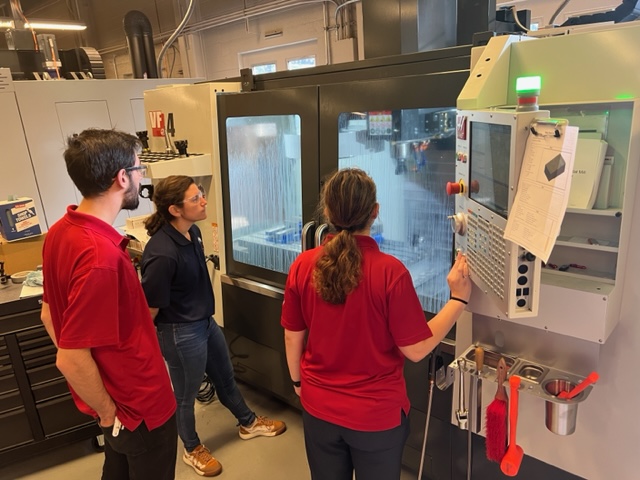
Since the online ACE training for Computer Numerical Control (CNC) machining was launched in December 2020, Tony has nurtured its steady growth to nearly 3,700 students from all 50 states. He serves as joint faculty for mechanical engineering at both the University of Tennessee, Knoxville (UT) and Oak Ridge National Laboratory (ORNL). He also leads several of the five day, in-person ACE training called bootcamps, where more than 300 students have gotten hands-on CNC experience within the past two years. Each student machines four parts of an oscillating piston air engine that they assemble and keep as part of the training.
The national testbed for ACE in East Tennessee has been so effective, that it has expanded regional machine tools workforce training and development centers in a hub and spoke model in North Carolina, Texas, West Virginia, and Florida with more states to come. “We established the ACE program because machine tools and machining are critical for the United States,” Tony emphasizes. ACE is supported by the U.S. Department of Defense (DoD) and managed by the Institute for Advanced Composites Manufacturing Innovation (IACMI), but how is the program scaling up?
Through a model called “train-the-trainer,” Schmitz and UT PhD students Emma Betters, Aaron Cornelius, Jake Dvorak, and Jose Nazario have developed a toolkit for educators to use and guide them step-by-step through the bootcamp so that they can become future ACE instructors. Emma says, “I look forward to seeing it spread to other places, a full range of high schools to undergrads to graduate students. Getting kids excited from a younger age, understanding that manufacturing offers a viable career they can do, is really important.”
FLORIDA
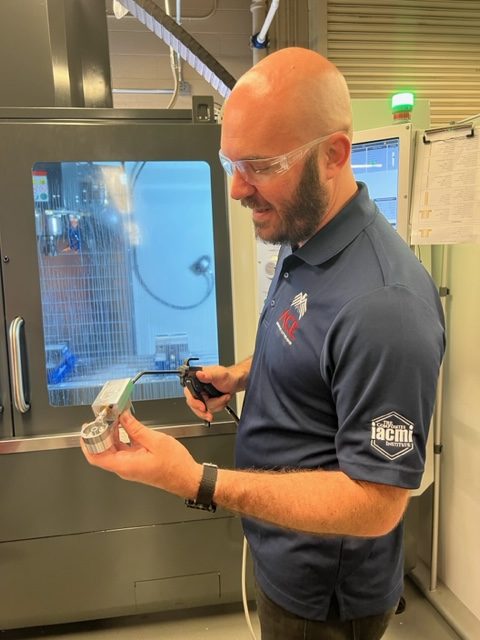
One of the newer ACE hubs is the alma mater for both Tony and Emma, the Herbert Wertheim College of Engineering at the University of Florida (UF). To get the full ACE experience, UF sent two teaching assistants as participants and one professor for train-the-trainer last summer so that all three would be prepared to teach the ACE curriculum. UF professor Sean Niemi says, “I want to completely revitalize the design and manufacturing curriculum we have for mechanical engineering at UF. I want to bridge to other departments so that anyone can do this. My goal is to reach a broad range of people who could benefit from these skills.”
In his first year of graduate school, Ilan Zarin is ready to see more hands-on CNC opportunities for UF students. “Giving them experience on these machines would be a game changer. Up until rather recently, designing and machining have been two different things. Once you get the hands-on learning and realize how to make practical designs, THEN you become a good designer.”
This couldn’t come at a better time for Florida. “COVID showed that the state was overly dependent on tourism,” Sean explains. “So now the state is focused on growing manufacturing and expanding the aerospace and defense industries. As someone who teaches mechanical design courses and enjoys manufacturing, I’m excited to see all the elements I’m passionate about coalesce in the ACE program.”
WEST VIRGINIA
Rick Smoot is another educator sent to become a trainer for Marshall University’s Robert C. Byrd Institute (RCBI). Rick has been a machinist for 40 years–he says as far back as when design was done with a calculator and pencil. Through ACE, he’s learning Computer Aided Manufacturing (CAM) software for the first time. “CAM is more user-friendly and intuitive,” shares Rick. “If you better understand the design aspect, you can get a deeper understanding of how it should be machined. That’s a plus, plus to me.”
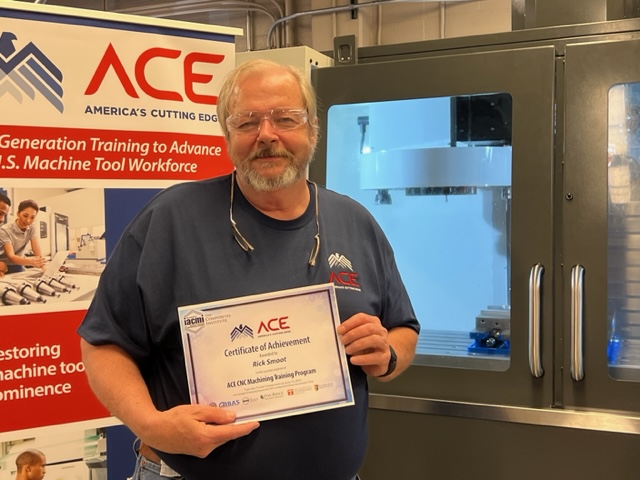
Rick has been pleased with how the ACE curriculum is expanding in West Virginia, Kentucky, and Ohio because he’s focused on national economic concerns. “We’re a nation of purchasers instead of producers. Manufacturing needs to be a big part of our economy. If our economy is more self-sustainable, we create more jobs and keep the money in our country. It all goes together to keep that engine running.”
Looking around the lab at students who are proud of what they’re making at ACE, Rick is optimistic. “Many of us older guys are retiring. I’m very hopeful when I see young people come into the industry where a lot is changing in technology. They’re learning the new skills they need.”
TENNESSEE
Closer to home, ACE is attracting a diverse group of educators looking to re-envision how to attract and train the next generation of manufacturers, from high school teachers to technical schools, from community colleges to universities. Chancellor Donde Plowman is thrilled the University of Tennessee, Knoxville makes that happen. “We know not everybody needs a four-year degree, but everybody needs a great job. There’s faculty, graduate students, adult learners, all mingling respectfully. You can feel engaged learning going on. I’m really touched by that and proud.”
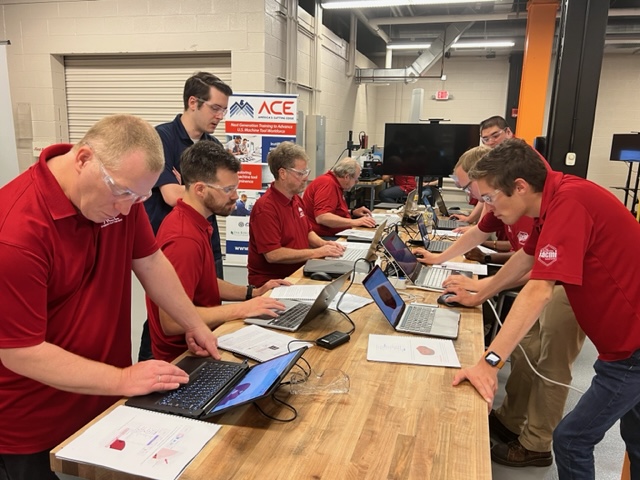
Tennessee high school teachers from Rhea, Hamblen, Anderson, and Knox counties all want to know how they can start bridging the country’s skills gap starting with courses for teenagers. Craig Short from Morristown West High School knows there are many local jobs in the automotive industry that will pay a starting wage of $24 an hour for high school graduates. “I’m in for anything I can learn for the kids,” says Craig. “I was in the machine industry for 22 years, and without a dad, I feel my machine shop teacher made a huge impact in my life. I’m trying to make a difference.”
Some teachers haven’t gotten the chance to get that hands-on experience until now. Nathan Kenner from West High School in Knoxville jumped at this training opportunity. “I’m here to learn how to machine and how the systems and science work. It’s more important for me to experience the student side of it. I’ve never experienced machining in my life. So, this is all new to me and really cool.” Nathan works with students all four years who have chosen machining as their elective. His students have specifically requested CNC opportunities. He adds, “They want it, they value it. Once they see the direct value, then they’ll be more engaged, and learning becomes more effective.”
Through grants, some high schools already have CNC machines and are working with local industries to fill a need. Most companies have smaller jobs with lower quantities that are not as profitable but need to be made. High schoolers properly trained could machine those parts, bringing income back to the students and the school. Dr. Mark Buckner at Oak Ridge High School explains, “At Wildcat Manufacturing, we’re setting up a business model to sustain the program and give students job experience. It’s a win all around.”
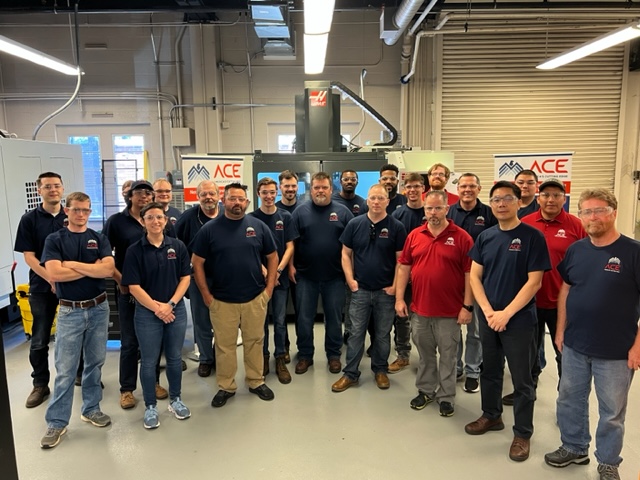
Justin Beaty is looking to do something similar in Rhea County Schools and sees it as a way to keep talent close to home. Justin is hearing from local manufacturers: “We need people. The next 10 years, many workers will retire, and we’re not seeing the new hires coming in. If you can train them, we will hire them.” After a week of instruction, Justin feels ACE gives him the tools to serve many needs in his community. Plus, it’s been a lot of fun personally. “I’m a big maker myself. Seeing that blank of material be transformed into something else and knowing I had a hand in it is rewarding. I’m going to be an evangelist and will tell others about ACE.”
That’s music to Tony Schmitz’s ears. He knows if we don’t work quickly, we could have 2.1 million unfilled jobs in U.S. manufacturing by 2030. He concludes, “We’re looking for an evangelizing community to take this message national and we want nothing less than eliminating the shortfall in the manufacturing workforce that exists today.”