America’s manufacturing future depends on the people who know how to build it.
Join industry, workforce, education, and defense leaders October 20–21 in Galveston, Texas to strengthen America’s skilled workforce and industrial capability.
Hear what’s working. Build partnerships. Take home strategies you can use.
Dec. 2, 2025 – Justin Maples didn’t originally envision a machining career for his life. Now, he’s doing everything he can to get people involved in one.
Justin is the lead trainer at ACE hub Wichita State University Tech (WSU Tech). We spoke to him about his motivations behind launching an ACE-focused podcast called MMAD (Machining Minds; ACE Driven) and why connecting personally with participants is critical to the program’s success.
America’s Cutting Edge (ACE): What’s your background?
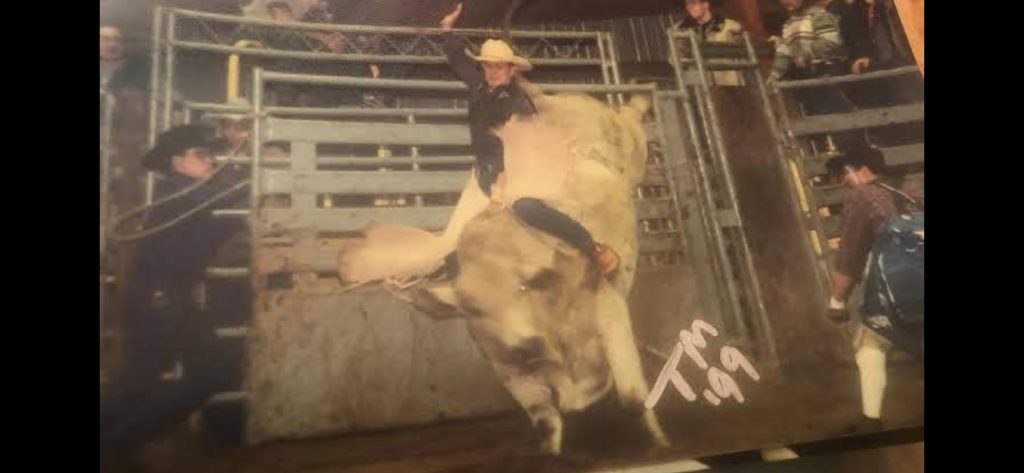
Justin riding a bull in 1999.
Justin Maples (JM): I grew up over in southwest Missouri. I thought I always wanted to rodeo. I didn’t even finish school. I just wanted to rodeo, and that was it.
And so, I tried the rodeo thing for a while, and I realized I was going to have to start working. I was working construction jobs and trying to make a living, and I just wasn’t making any money.
I had a cousin of mine that went over to a machining class at a vo-tech there in southwest Missouri, and I never knew what machining was. I ran into my cousin in a grocery store one day, and he said, “Man, won’t you come work for me?”
And I said, “I didn’t go to college, so, you know, I can’t do any of that machining.”
And he said, “Oh yeah, you can. I’ll show you everything that I know.”
My first machine shop was with him. It was a manual machine shop, and we rebuilt hydraulic cylinders. It was just me and him working side by side. I got to learn a lot from him.
I went on and took my GED in 2013 and moved out here to Wichita, Kansas. And I tried to get a job in a machine shop because that’s what I loved to do. But I didn’t even know what CNC stood for.
I’d never seen a CNC machine. So, I couldn’t get a job as a machinist because I didn’t have any experience.
So, I actually went to WATC – it was Wichita Area Technical College at the time, which now is WSU Tech, where I work.
So, I went through that program and learned all I could, and I went out and worked in machine shops for a couple years and actually came back and started teaching.
ACE: You can come to ACE with absolutely no experience and get trained. Similarly, that’s what happened to you – you went to your cousin, you had no experience, and you got that training. What was that feeling like of having somebody giving you that chance?
JM: When I was working for him over in Missouri, I went from pouring concrete and doing really, really tough jobs to being inside of a shop.
When it was raining, I wasn’t getting wet. When it was cold out, I wasn’t freezing to death. When it was hot, I wasn’t burning up.
I got to work inside. I got to use my head a little bit instead of my back.
So, him bringing me in and showing me a different way to make a living, you know, that was amazing. He wasn’t judgmental because I didn’t go to college or even high school. He knew I would catch on if I wanted to.
ACE: And then one day, you get in front of a CNC. What was that like?
JM: It was awesome. I’d worked on manual machines for so long and I knew what it felt like to cut metal.
I knew what was going on when a tool started chattering. I got to experience all that firsthand on a manual. And getting in front of a CNC and being able to write a small program by hand and get a tool to do something without even turning any knobs was crazy to me at first.
But the more I did it, the more I absolutely loved it. I had that foundation of manual, so it was amazing to be able to see what CNCs could do.
ACE: Let’s fast forward because you mentioned getting to WSU Tech. You’re an instructor there. How did the ACE program land at WSU Tech?
JM: It’d be the vice president of manufacturing, Dr. Scott Lucas. He was on a committee with Kim Harris.
He comes to me and says, “Hey, I’ve got a training that I want you to go to.”
He said, “If you’ll go to this training, we’ll see what it’s all about. And you come back and tell me, and we’ll go from there.”
That’s about all that I knew. I didn’t really know what I was getting into.
And I was like, oh man, I got to do all this online stuff. But I just dove into it and got it done.
I always say on my podcast, and I always say when I’m talking to other schools, when I went to ACE training, I thought, this is going to be just like any other training. They’re going to try to get me to buy this, or they’re going to try to get me to buy that or start teaching this way.
But when I went to the ACE training, nobody was trying to sell me anything. All they were doing was giving me a program that I could pass on.
There were better ways of teaching what we were already teaching. And students out into the shop within 30 minutes of being in class was probably the biggest thing to me.
So, I came back from the training and I told Dr. Scott this is something that we need at WSU Tech.
Our students need this. Industry needs this.
We became a site and we started training our students in it.
ACE: What made you want to start a podcast solely about the ACE program at WSU Tech?
JM: So here’s the deal. My job is to go out and tell people about the ACE program and try to bring people into the trainings. I always say I’m a salesman that is not selling anything. I’m giving it away.
But nobody really knows anything when it comes to the ACE program around Kansas.
So I thought, I’ve got quite a few people on LinkedIn that read some of the stuff I put on there. I’m going to start a podcast just to get the word out.
I talked to a guy recently from Oregon. I had actually met him at HTEC.
I sent him over my podcast and he said, “I’m going to share this with everybody over here on the West Coast.”
So, that’s what it’s for, is for people to know about ACE.
ACE: Who have you interviewed?
JM: The first podcast was with Dave Roberson and Jose Nazario, the lead instructors for ACE.
And on the second podcast I had a group that was in the training.
The next one that I had was Nathan Panak from Texas A&M.
Then I did a Train the Trainer with the Kansas Army National Guard, and it was amazing. So I was like, I have to have these guys on the podcast.
So that will be the next one that comes out. And then Daniel Robles from Houston will be the fifth one.
ACE: As an instructor, why do you believe it’s important to get to know ACE participants?
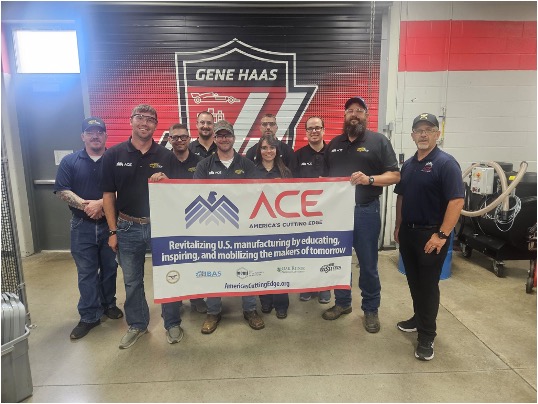
Justin (right) with a group of ACE participants and ACE Instructor Trainer Dave Roberson (left).
JM: I want to make sure that everybody going through the bootcamp gets personal training.
When I take somebody out to the machine and I train them how to run, say, the base part, that person then has to turn around and train the next person that comes up.
If you’re not getting to know everybody that’s going through your camp, if you can’t get personal and care about the 10 people that are going through your camp, you must not care much about machining. I think it’s very important to get personal with every participant.
You never know when they might be training people under you.
ACE: I imagine through that process, you get to meet some very cool characters.
JM: Oh, absolutely. And I do this on purpose – so I might have a 17- or an 18-year-old and let’s just say a 55-year-old in my class.
I will purposely make it to where those two have to come out to the machine together. I’ve talked about it on my podcast too with Nathan – you’ve got this high school kid or somebody that’s just graduated high school that’s deep into technology.
And then you’ve got this 55-year-old that’s in the same class.
They’re learning the same stuff, but maybe not into technology as much, maybe into using their hands or figuring stuff out with a pen and paper and opposed to using their calculator on their cell phone.
That’s the kind of connections that I like to make because otherwise the older man or woman and the younger kid are not going to have a connection if you don’t make them have that connection.
We also like to take them out on Wednesday nights to Top Golf. It’s the shortest day of the bootcamp. Everybody kicks back. We get to know one another outside of the classroom setting.
ACE: Why do you think going out together is such an important element?
JM: Kicking loose. When you’re teaching and you’re in class, it’s always a pretty serious thing.
There’s cutting up and we have fun and we talk, but we really don’t cut up like we do when we go out, you know? And I think that’s very important.
Even when I have a class here at WSU Tech, before I moved over to the ACE program, we always had barbecues in the machining department.
And that was because we’re going to learn for three weeks straight, and then we’re going to have a barbecue just to break it up, to break up the monotony of being in the classroom.
And you learn a lot about a person when you’re out at Top Golf or when you’re at the bowling alley or when you’re standing around a barbecue grill that you won’t learn while you’re standing up in front of a classroom.
ACE: It’s that human element.
JM: That’s exactly right.
ACE: Is there anything that you want to mention?
JM: I don’t care if I’m ever podcast famous. I want to show the ACE program. That’s all I care about. That’s the only reason I’m having it.
You can listen to all episodes of MMAD by clicking here.
We use cookies to ensure that we give you the best experience on our website. If you continue to use this site we will assume that you are happy with it.