America’s manufacturing future depends on the people who know how to build it.
Join industry, workforce, education, and defense leaders October 20–21 in Galveston, Texas to strengthen America’s skilled workforce and industrial capability.
Hear what’s working. Build partnerships. Take home strategies you can use.
How a Minnesota student is using robotics and manufacturing skills to improve prosthetics
Summary: Connor Anderson discovered a passion for manufacturing through FIRST robotics and expanded his skills through ACE training at Bemidji High School. Now, he plans to pursue electronic engineering and biomedical engineering degrees with the goal of developing more advanced, affordable prosthetics that can help improve lives.
August 19, 2026 (Bemidji, Minn.) – If you asked Connor Anderson whether his family was more left- or right-brained, he’d have an easy answer.
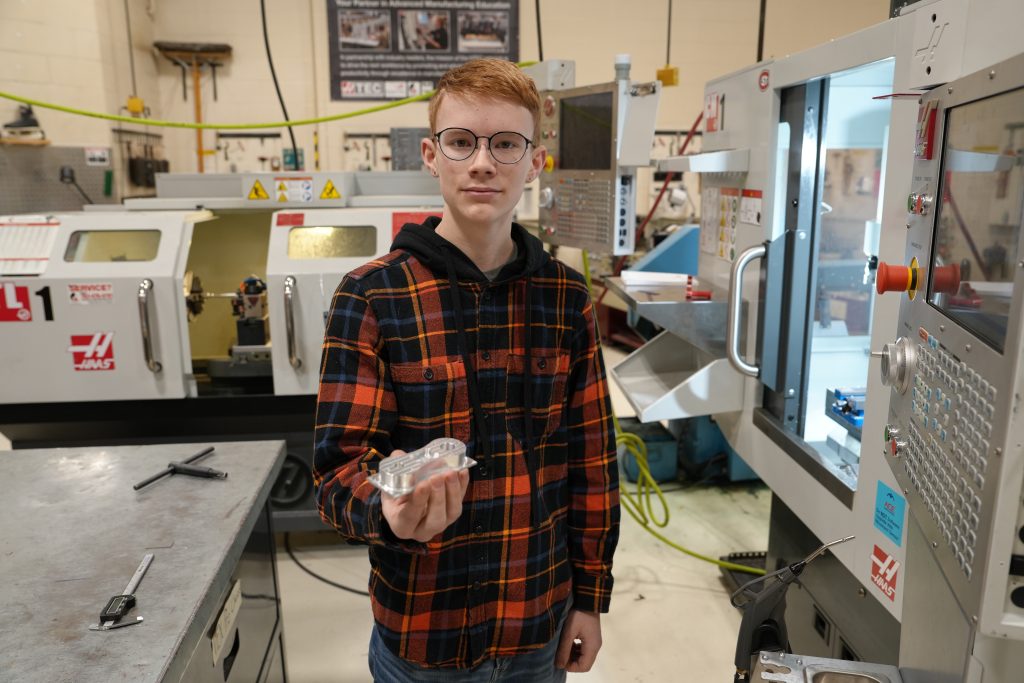
Connor Anderson holds his ACE air engine.
“Right-brained,” he’d say, without hesitation.
Ask which side describes him best, though, and the Bemidji High School senior’s answer changes.
“I’m more mechanically-inclined,” he’d say.
That mindset led Connor into FIRST robotics, where he discovered a passion for manufacturing.
Today, it’s helping shape an even bigger goal: earning degrees in electronic engineering and biomedical engineering to develop more advanced, affordable prosthetics that can help improve people’s lives.
Through FIRST robotics and hands-on manufacturing training, Connor is already building the skills he’ll need to pursue that future.
How FIRST robotics introduced Connor to manufacturing
When Connor got involved in FIRST, one of his favorite aspects of the program was the freedom to solve problems.
During competition, teams must complete a variety of objectives. It’s up to them to determine how to accomplish those goals with a robot they design and build themselves.
“It’s so much fun,” he said. “There aren’t big rules on what you can make. It’s just how to solve the problem, how to do the job.”
Over the years, Connor has taken on a variety of roles, from wiring his team’s robot to serving as build lead.
This spring, he added another set of manufacturing skills through ACE training at Bemidji High School.
“If we need to manufacture some parts, I know how to use the CNC machines to get them made,” he said.
The experience gave Connor hands-on exposure to CNC machining, knowledge he says helps him contribute more effectively to his robotics team.
“Having the knowledge ACE provides will put us ahead,” he added.
Building skills for a future in prosthetics innovation
Even though he doesn’t graduate until next spring, Connor is already focused on the next steps in his journey.
After graduation, he plans to pursue degrees in electronic engineering and biomedical engineering.
His goal is to develop prosthetics that are more advanced, faster to produce, and more affordable.
“I just think that’d be so cool to help people gain something if they want to have it,” he said.
Connor believes the manufacturing skills he’s developing now will help him get there.
Through ACE training, he gained experience using Fusion and learned how to move from a digital design to a manufactured part, a process he sees as directly relevant to his future work.
“I could model and manufacture the parts for the prosthetics,” he added. “I’ll have the skills to make them more intricately designed and made cheaper.”
For Connor, that combination of design and manufacturing is what makes his dream exciting.
Inspiring the next generation of manufacturing innovators
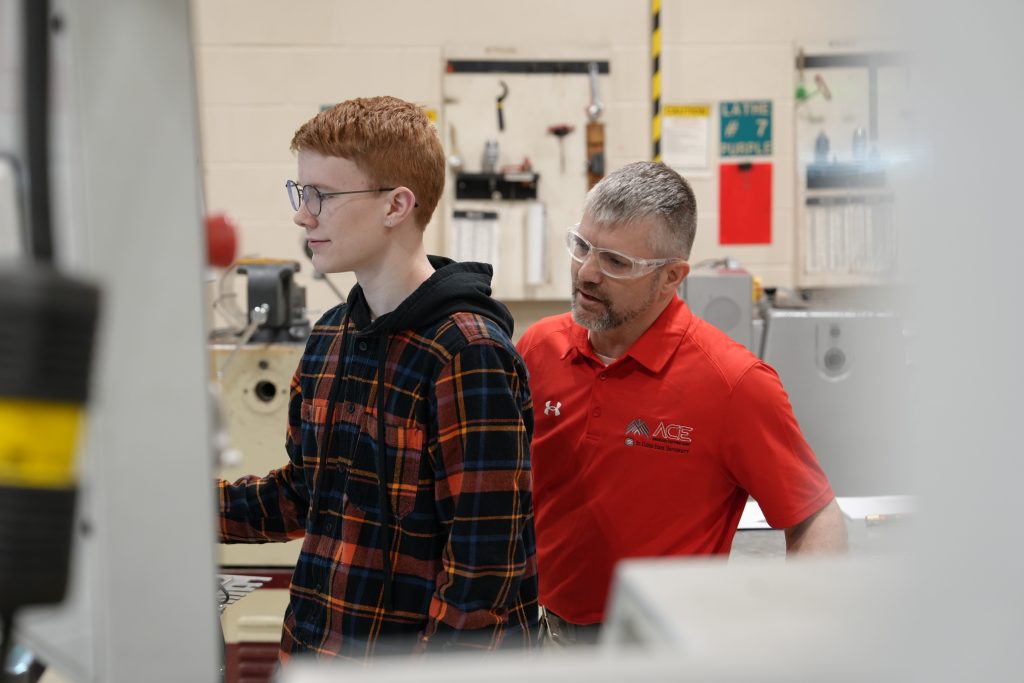
Nick Rowland (right) looks on as Connor Anderson (left) works on a CNC machine.
Connor’s journey reflects what Nick Rowland, Bemidji High School industrial technology teacher and ACE instructor, hopes students gain from the program.
It starts by encouraging them to imagine possibilities that don’t yet exist.
“They should bring their imagination into real, tangible existence,” he explained. “It’s as close to magic as we can get to as humans.”
Connor hopes other young people can experience that same magic.
But it starts with taking the first step of experiencing it firsthand.
“Manufacturing is not as inaccessible or complicated as what people think,” he said. “Once you learn about it, it’s very easy.”
We use cookies to ensure that we give you the best experience on our website. If you continue to use this site we will assume that you are happy with it.