America’s manufacturing future depends on the people who know how to build it.
Join industry, workforce, education, and defense leaders October 20–21 in Galveston, Texas to strengthen America’s skilled workforce and industrial capability.
Hear what’s working. Build partnerships. Take home strategies you can use.
How this ACE participant plans to make a future out of the past
Story summary: Collin Mullins, a Mississippi State University mechanical engineering graduate, got his start in manufacturing at a young age by hearing about his grandfather’s work as a programmer. His childhood was spent tearing things apart to learn how they worked. Today, he looks to use the skills he gained through America’s Cutting Edge to help keep older industrial equipment running for future generations.
Sept. 25, 2026 (Starkville, Miss.) – It probably felt like a headache to Collin Mullins’ mom: her son had torn apart the vacuum cleaner.
Among the activities parents want their children to do, getting inside of the very thing used to clean the floors probably doesn’t rank high on the list.
“I was just curious on how it worked,” he said.
That curiosity showed up early and often. As a child, Collin was always trying to understand the inner workings of the things around him. Taking them apart was the easy part.
Putting them back together? Well, that took a little longer.
“Tearing things down would take 20 minutes. Putting it back together? About two hours,” he added with a laugh. “But after I put them back together, they worked!”
That desire to understand how things work eventually led him to earn a mechanical engineering degree from Mississippi State University this spring.
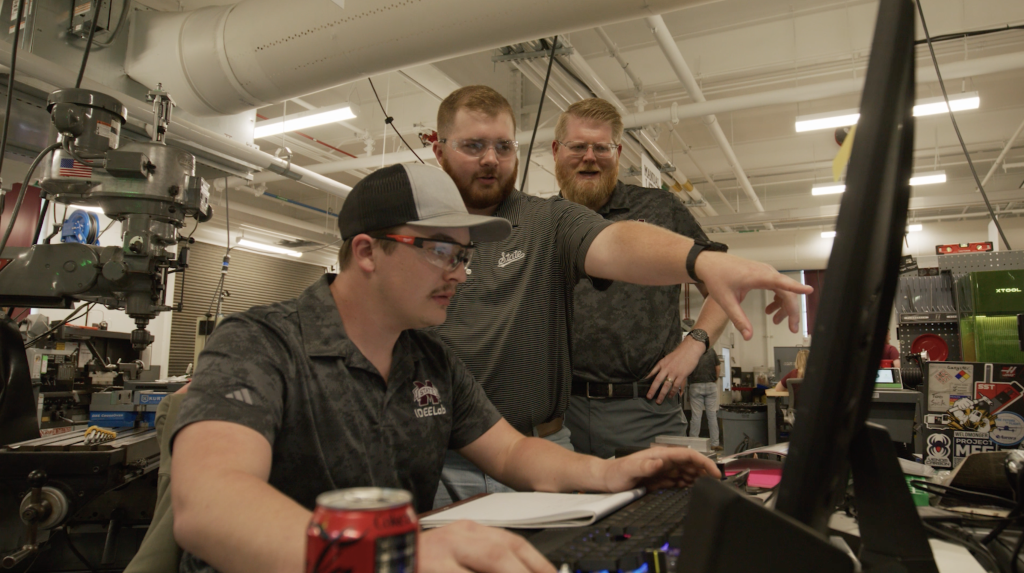
Collin Mullins (left) went through the ACE bootcamp at Mississippi State University.
But long before college, another influence helped shape his interest in manufacturing.
Following in his grandfather’s footsteps
Collin grew up hearing stories about the work his grandfather did as a programmer working with CNC machines.
“In my head as a kid, I just thought about these huge contraptions making parts for airplanes and stuff,” he said. “He told stories of them. I thought of them as something only big companies could ever afford.”
Those stories stayed with him.
Years later, Collin found himself experiencing a version of that work firsthand through an America’s Cutting Edge CNC machining bootcamp at Mississippi State University.
Participants in the program get classroom instruction, learn computer-aided manufacturing (CAM), and gain hands-on experience operating CNC machines.
For Collin, it opened a door to a world he had only heard about growing up.
“We were learning how to turn something on a screen into an actual part in your hand,” he said. “It exposed me to a world that I probably wouldn’t have ever been able to see.”
Building skills for the future
Mississippi State University became an ACE partner in 2024 and has since helped hundreds of participants get exposure to CNC machining and advanced manufacturing skills.
According to Ross Smith, director of the MSU IDEELab and ACE program manager, the training helps better prepare students for careers in industry.
“The experience they have going through the ACE training is going to make them better employees,” he said. “It helps give you a leg-up. ACE prepares them for day one.”
Students who have completed the training say the experience provides valuable hands-on skills that complement their classroom education.
Rylee Hempstead went through the ACE bootcamp at Mississippi State University.
“I can do so much more now that I’ve had this training,” said MSU student Rylee Hempstead. “It makes me look really valuable to companies.”
“It was beginner-friendly and really helpful,” added MSU student Spandan Nirovla. “The knowledge I gained will help me in my future as a manufacturing engineer.”
Bridging past and future
The manufacturing facilities of today are very different from those of previous generations.
Modern shops are often cleaner, safer and more automated, while today’s CNC machines can produce parts with speed and precision that earlier manufacturers could only imagine.
Yet it’s the older equipment that continues to capture Collin’s attention.
He comes from a small town where some companies still rely on machinery that’s been running for decades. He says one local sawmill still operates equipment dating back to 1929.
For Collin, that equipment represents an opportunity.
“I don’t think anyone makes a lot of parts for those,” he said. “I’d love to have my own machine where I make one-off parts for that older equipment. Someone’s got to make it. Why not me?”
We use cookies to ensure that we give you the best experience on our website. If you continue to use this site we will assume that you are happy with it.